Wood Stories
Winter 2025

Being 70
Just after my birthday, I flew to Europe and explored a bit of France, Spain and Italy. This is a compilation of photos, diary entries, and letters home. It’s long. If you don’t read it all, you’ll still be my friend. But it was an adventure with all the magical/exciting/scary/boring bits that accompany them.
The Balcony of the Mediterranean.
October 18
After a smooth series of trains out of Leeds, the shit hit the fan at my first hurdle in Paris. My son, Bevan breezed through the gate into the Metro, but I couldn't get any of the kiosks to work. There were no staff to help, it was rush hour, and no one wanted to speak English. With a rising panic, I flapped around the station, then returned to Bevan who was standing on the other side of the glass turnstiles next to a large, barred gate. Resting my backpack against it, it swung open. I slipped through. After an otherwise uneventful night in Paris, we boarded a train for Marseilles
What a city! We wandered around the quay and the touristy areas, then found our way to the edgier neighborhoods for beer and Moroccan food - delicieux!!
The next day, we caught a bus to the edge of the city and the beginning of the Calanques National Park. The GR51 is a public footpath that goes from Marseilles to Monaco. It is also known as "The Balcony of the Mediterranean", as much of the time, you're looking out at the sea as you hike. Bevan and I only walked the first 35 miles, but, my god, is it beautiful!
...but my god, is it difficult!
We walked 8 miles on the first day, 10 miles on day 2, then – in training for a later adventure – 17 miles on day 3. Day 1 was hardest because I didn't know what to expect, and in my inexperience, pushed myself too hard. Day 2 was the most beautiful. Day 3 was far less dramatic than the previous 2 days, but ended with a swim in the sea in a secluded fjord. (A calanque is the French equivalent.)


On our 4th day, we returned to the lovely seaside village of Cassis, rented kayaks, and explored the Calanques by sea, along with more Med swimming.
I'm back in Marseille now. This morning I saw Bevan off on the train home. Tomorrow, I will meet my friend, David Newell at the airport, and we will ride the rails to Cordoba, Spain.
Andalucia
October 22, Cordoba & Seville
While waiting at Marseilles Airport for David Newell, I realized that our 22-hour journey to Cordoba began with 17 hours on a BUS! When David arrived, he insisted that we not re-book onto another train, but endure the journey. After all, this was supposed to be an adventure and they come with challenges.
He might of regretted this when at about 2 AM on a packed bus, a bloody fistfight broke out just next to us. Fortunately, the combatants got off soon, as did many of the other passengers allowing David and I each to stretch out across 2 seats for the rest of the 13 hours on a bus.
Once in Cordoba and settled into our apartment, we went outside to a bench for a glass of Monkey 47 (our favorite gin from our teaching days). From a storm door behind us came muted but raucous live Flamenco music. I stuck my head in and asked if we could leave the door ajar so that we could hear better. Here is where we ended each of our 3 nights in Cordoba.

This sign was on the door to the Flamenco School. It translates to "The rhythm of my spots." (!?)
Two of our days we visited the Mesquita mosque, built in AD 785 and converted to a cathedral in 1236. My architect friend, Jacob Comerci said that this is his favorite building, and I can see why. It's basically a salvage project right from the beginning as all of the 865 columns used to build it were taken from other structures. In order to get all the columns to a uniform height, some were buried partway in the ground. To get the short guys to the proper height, they designed a double arch structure, alternating red and white bricks into a striped pattern. It looks like it was designed by Dr. Seuss. In the middle of all this, the Christians plunked a giant church with ornately gilt iconography that left me cold. (More on that later.)


As a treat, David booked us into a Turkish bath and 1 hour massage. For a masseur, I was hoping for a burly Moor who just had an argument with his wife and needed something to take it out on. Instead, I got a young Spaniard with almond eyes and a smile that breaks hearts. (I guess she'll have to do.). This was supposed to be a full-body massage, but she instinctively focused on my stiff neck, my sore feet, and my tired hands. I felt like I was floating on air for the next 3 days.
We next moved to Seville and into a youth hostel. The hostel itself was quiet, but it was located centrally on a large square that was hosting a weekend concert. I didn't sleep at all and the next day it took all my energy to not be a pouty brat.
David wanted to see the Alcazar Palace, but advanced tickets were sold out, so we stood in line for 3 hours to get same-day passes. I hate crowds and I hate lines, so my mood and attitude were not at their best. After the palace, we stood in more lines to see the Seville Cathedral. I was just bad company all day.
What's my problem?
I think, basically, in situations like these, I see myself as a sheep ticking off bucket-list items that I'm told to tick. I've been to grand cathedrals and Muslim palaces before, and the purpose of all that opulence elicits nothing in me. What I find absolutely fascinating is the work of the craftspeople who built these structures and the organization it must have taken to put it all together. What was the tile industry like and how did they go from design to clay to glaze to delivery to flawless installation? What was it like for the carpenters who built the structure onto which they erected the stone arches? But, you know? I could ponder that in any English village chapel.
It gets better, I promise.

I bought a new pair of walking shoes in Marseille, so after I broke them in, I left my old ones with this guy in Cordoba.
October 23, Duende
I saw the Flamenco and it changed me. ...or at least it told me why I'm here in the south of Spain.
This wasn't a group of lithe, young street performers busking for change – although we saw plenty of them. We attended a performance at the Museum of Flamenco, created by one of the top choreographers, and performed by among the best dancers, singers and guitarists in the genre.
Perhaps 'performance' is not the right word for what we saw, for this ensemble wasn't pretending anything. This was ritual. David and I had front row seats at the side of a small thrust stage and we could see that when they made eye contact with each other, they were not cuing or signaling anything. Those eyes only conveyed the joy of operating as a unit: sensing, breathing, singing, moving as a single energy source.
Of course it was seduction and sex and heat, but it was so much more. It was the Muslim call to prayer; it was a stampede of horses; it was a battle for life, for everyone on that stage was well into their 40s and although the performance was flawless, it required enormous physical struggle that cost them something.
I had to return to Federico García Lorca's 1933 lecture, "Theory and Play Of The Duende", which I read 40 years ago, but never really understood. I don't understand the whole thing now, but I'm getting closer. It's a dense piece, but here are some quotations that resonated with what I saw:
"It’s no accident that all Spanish art is rooted in our soil"
"The duende loves the edge, the wound, and draws close to places where forms fuse in a yearning beyond visible expression."
"The duende charges itself with creating suffering by means of a drama of living forms, and clears the way for an escape from the reality that surrounds us."
"But it’s impossible for it ever to repeat itself, and it’s important to underscore this. The duende never repeats itself, any more than the waves of the sea do in a storm."

After that performance, everything changed. Remarkable things just started to happen to us. We stumbled upon the most characterful restaurants and found ourselves at the best tables; wandering around the old working class area of Triana, we edged into the packed sailor's chapel where the float of Esperanza was on display. Esperanza is the patron saint of sailors and bullfighters, and when we walked past the famous Seville bullfighting ring, we found it open. We went inside. I'm glad that bullfighting season had just ended, because I would have been sorely tempted to go.

Here's Lorca again:
"[The] most impressive effects [of the duende] appear in the bullring, since it must struggle on the one hand with death, which can destroy it, and on the other with geometry, measure, the fundamental basis of the festival.
"The bull has its own orbit: the toreador his, and between orbit and orbit lies the point of danger, where the vertex of terrible play exists"


The next day, we decided to grab breakfast at the Triana market, but we were stopped in the middle of the Triana Bridge by a large crowd. The float of Esperanza was coming across.
30 muscular young men with sackcloth on their heads were underneath carrying the float on their shoulders. They cannot see where they are going but are guided by leaders front and back, and by the rhythm of a marching band. The sight of Esperanza on the Triana Bridge is one of the most important events of the city. Because it was not Easter, but a lesser holy day, we got to be right there.


I came to Spain because I was inspired by a book (more on that later), and because I wanted to walk the first 133-mile stage of the Via de la Plata - a 620 mile walking trail up the spine of Spain. I don't know if I can do this, but I guess that's the whole point. The duende says I have to try.
October 30, Gypsies
I'm an idiot.
I arrived in Granada not thinking that tickets to the Alhambra - the grandest of Moorish palaces, the reason you come to Granada - might be sold out weeks in advance. David had flown home after Seville, so I wandered around the city feeling sorry for myself, thinking that I'm hopeless at touring foreign cities alone; worrying about my 200 km hike, that I'm not fit enough, and that I'll have to be airlifted out by mountain rescue.
Then I discovered that there are still cave dwellings up in Sacromonte, the old gypsy corner of the city; that people still lived in them, and that there was a small museum there. So, I wandered up first thing in the morning, and to my delight, it was mostly still a working class neighborhood: young children running down the steep paths to school; tradesman trudging off to work; women exchanging gossip from path to balcony. This little spot is nothing like cave dwellings in Matera, Italy - a magnificent city that should not be missed! - but as far as I know, no working class families live there anymore. This, in comparison, felt real and un-gentrified.

Sacromonte with a view of the Alhambra palace in the background
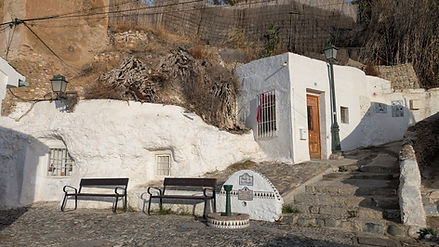
The museum features nine caves depicting life in the community, plus displays of other cave dwelling communities throughout the world, a history of the gypsies, and film footage of Sacromonte life from 1963. (NB: "gypsy" is the term they used in all their signage. Sorry if that offends.)

This was not the high artistry that I saw in Seville — but it was a lot more fun! It had the atmosphere of a rent party with the Gypsy Kings as the house band. And they were certainly talented. But they laughed, and sang, and shouted, and danced, and passed out drinks, chattering away to each other all the while.


It was a great evening, and I walked home in the rain with a spring in my step. Tomorrow I head back to Seville and start the Via.
Maybe I can do this.


There is some evidence (myth? rumor? legend?) that the flamenco started in these hills. The Sacromonte people have their own unique style, called Zambra. With a bit of research, I found a tiny, out-of-the-way cave venue that has been performing Zambra for over 100 years. Off I went.


The Via de la Plata
October 31
I set off this morning at 6:30. As usual, Google maps was being a little bitch. She refuses to give me reliable directions before she's had her first cup of coffee. So, the route to the Triana Bridge from my hostel was creative. Once there, I could changed over to a topographic map with the route layered over it as a GPX file. This is much clearer, plus the Via de la Plata is well marked (until it isn't).
The first ten miles were pretty shitty: bad, potholed highways lined with with used tire stores and motorcycle chop-shops. Then I got onto a dead-straight Roman road all the way to Guillena where my auberge (hostel) is located. For a while I couldn't figure out how to contact the landlady, which was a brief moment of panic, but I eventually got in.
I've got a private room for €17, and the 'menu del dia' at the nearby restaurant was €11.50 for 3 courses and 2 beers.
Two of the others here are a retired couple from Alaska. This is their tenth Camino route! Nice folks. They gave me a beer, and perhaps more importantly, some valuable tips and resources for walking the Camino. Apparently, this time of year, not all inns are open, and I could wind up sleeping outside if I don't do some pre-planning (contrary to what my guide book says).

If you look carefully, you can just make out a rainbow. I was hoping for a pot of gold at the end of it; instead I ran into a flooded bit that required fording it up to my thighs.
November 2
I did it!
This was the hard one that had me so worried about doing this walk: 19 1/2 miles with 2000 feet of ascent. Of all the days on this section of the Via, this was the only one rated V. Diff.
I set off at 6 AM, and walked the first hour and a half in the dark. The first 10 miles was along a quiet road - not difficult, but steadily wearing. The kicker came at the very end where I had to climb 500 feet over half a mile. It was blistering hot and I was tired and sore. Standing in the shade of a tree, I would pick out another bit of shade 50 yards away, then climb to that spot to rest and take a drink of water. Rinse and repeat until the summit. The trip down into town was almost as painful.
OK! I promise, no more bragging and statistics. It's just that this one scared the bejesus out of me. Tomorrow is less than half the distance. I think I'll take my time setting off and try to take a more leisurely pace.


This is a shot of that steep bit at the end of the day.
November 3
The Via de la Plata is one of the hardest routes of the Camino de Compostela. It's also considered one of the least interesting, and with no others to compare it to, considering my past 3 days, I might agree. (Today, day 4, was short and beautiful.)
So why did I choose this route, one might ask? - not that anyone has. (C'mon, guys! Pick up your cues!)
I'm in the unique position of having no family obligations, I don't have the resources (or the inclination) for a luxury holiday, and (remarkably!) for a 70 year old, I'm pretty fit. I've fallen in love with the idea of a journey since 2009, when my girlfriend asked me to join her crossing the Pyrenees.
Finally, Bevan gave me the book, "As I Walked Out One Midsummer's Morning", by Laurie Lee. It's a great memoir, poetically written, where, in 1933, at the age of 19, Lee leaves his Cotswold home with only a bed roll and a violin, and winds up walking the length of Spain. Why Spain?
"So where should I go? It was just a question of getting there—France? Italy? Greece? I knew nothing at all about any of them, they were just names with vaguely operatic flavours. I knew no languages either, so felt I could arrive new-born wherever I chose to go. Then I remembered somewhere or other I'd picked up a phrase in Spanish for 'Will you please give me a glass of water?' and it was probably this rudimentary bit of lifeline that made up my mind. I decided to go to Spain."
Such innocent and arbitrary decision making I find appealing, and with similar naivety, I decided that Andalusia was the most Spanish of places to start.


These are cork oaks. Farmers carefully remove the thick bark for the wine industry, then must wait ten years before the bark has grown back enough for the next harvest. In Autumn, farmers run their pigs through these woods for the cork acorns. This is what gives Iberian ham its distinctive flavor.
My first 3 days were hard work: getting out into the countryside, figuring out how to find and get into aubergues and getting through that long-feared Day 3.
Last night I stayed in the tiny village of Almaden de la Plata, with a population of 2000 and boasts a ham factory and a bullring! Coffee in a tiny and characterful bar, then a lovely stroll in perfect weather through farmland.
I'm now in El Real de la Junta - another small town that has a castle! This is my last day in Andalusia. Tomorrow I enter Extremadura.

Coming down into El Real de la Junta

A wether is a castrated sheep. For the brief time I was a shepherd, I got the reputation of being the fastest and most prolific castrater in the dale. (Some of us need to take our acclamations where we can get them.) If, in the fog or over a hill, you want to know where your sheep are, you tie a bell around it's neck. This is where we get the term bellwether.
November 4
Day 5 was a not-too-difficult 13 miles. The first half was a lovely, cool morning along a farm track. Then the trail turned into shitty scrubland between a highway and a motorway for a few kilometers. The day ended with a long, hot slog up the road to Monesterio.
I'm wearing down. I've been nursing a sore throat for a few days now. Day 6 promises to be a relatively tough 18 miles, and the weather report says violent thunderstorms will blow through just about the time I could be most exposed. So, I'm going to take a day off, here at the halfway point of my walk. I'll stock up on sausage, cheese and trail mix, do some laundry and read a bit.
Also, Monesterio boasts the Museo Micológoco and the Museo del Jamon, so look out for important updates on mushrooms and ham!


Halfway there.
November 8
The Mushrooms Museum was a bust. The lights were out through most of it (ironic, but not intentional), and what I could glean from the English QR codes, I had already learned from Merlin Sheldrake's, "Entangled Life" (a wonderful book by mycologist with a name you could conjure with).
The Ham Museum, however, was fascinating. It described in scientific detail the interplay among the climate, the diverse livestock, the oak trees, the soil (& its mycology!), and the people who contribute to the making of their unique Iberian ham.
The exhibition ended with a documentary of the ancient ritual of slaughtering and butchering a pig—and they left nothing out except the actual slitting of the pig's throat: the preparation of the yard and equipment, the hog tying, the bleeding, gutting, sausage making and final celebration were approached almost as a religious ceremony.
This is why I’m here! Not for the grand palaces, but for the working people who live off this land. This documentary, along with my travels through Spanish farmland, brought me back to my years on my sister-in-law’s hill farm and to our tiny smallholding in the north of England. Back then, living and working was regularly tempered by scarce finances, inadequate equipment, unpredictable livestock, and the wrong weather. I never felt more alive. On the farm, we did everything we could to raise the happiest, healthiest sheep that we possibly could. And then we killed them (or more often, sold them off to be killed). I wonder if struggling to live a spirited life, while being this close to death is a source of duende.


November 9
The second half of this walk has been noticably different from the first. I've left the beautiful dehesa farmland with it's hills, oak forests, and livestock, and for the last two days, I've just walked past flat, empty plowed fields. The weather has turned chilly and there is some urgency to get to my next alburgue before the afternoon rains. This is the third hostel where I am the only resident. It has become less of an adventure holiday, and more of a lonely slog. But really, that's kinda the whole point. It might be the last opportunity for this old man to voluntarily push himself physically and mentally through exhaustion and boredom.

I walk in silence - no music, no podcasts - just the faint noise of the surroundings and the click-clack rhythm of my walking sticks. Not as punishment; it's what I prefer. So, what do I think about?
Nothing
Really! That makes me either a perfect Buddhist or the village idiot. Inevitably, my mind drifts towards you, my friends and family. I guess that this type of asceticism leads one to reflect on what's actually important to them. ... and that's you guys.
Thanks for following this, and for joining me in my imagination.

November 10
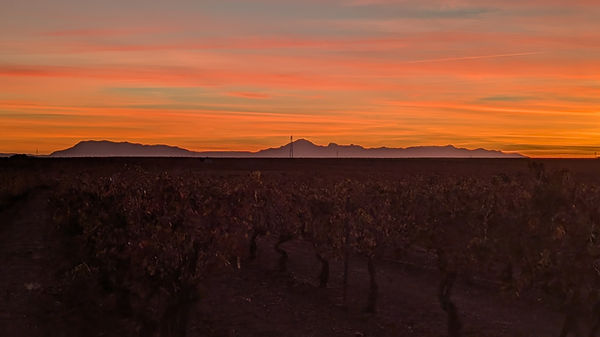
I was not looking forward to this walk. It was nearly as long as my dreaded 'day 3', but very flat. The guide book said it would be boring. In fact, it turned out to be delightful! I set off early, caught a gorgeous sunrise, and enjoyed how the morning light played on the fading vineyards. It became a beautiful sunny day in the high 50s - perfect walking weather.

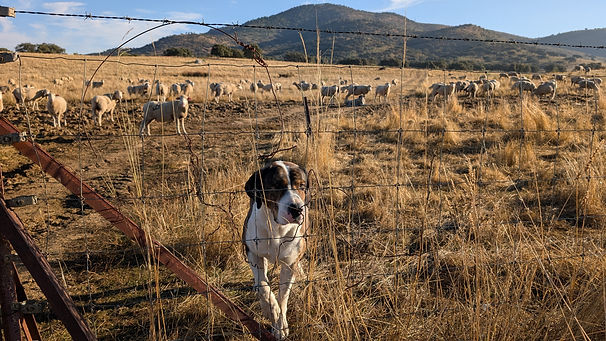
And it was Sunday. The path was filled with cyclists and runners, and because it was November in Extramaduro, it was small game season. The vineyards were teeming with hunters and their dogs stalking rabbits and partridge.
About a kilometer outside of Torremejía, I began hearing music. And at the entrance into the village, my path was blocked by the town percussion band in rehearsal.

My last night in an aubergue, I shared with a 78 year old cyclist, who, if his stories are to be believed (and why shouldn't they be?), has cycled ALL over the world and was now headed to Kenya to check on some children he has been supporting.
I'm tired. And rereading this, I see that it's becoming just another Euro-journey account. I need to find closure.
November 11
Yesterday, I completed my journey: 200 kilometers riding Shank's Pony (an archaic Scottish phrase for traveling by foot). I'm now in Mérida - a town built by Augustus for retired soldiers (how appropriate; perhaps I'll stay). It boasts the most extent remains of Roman architecture in Spain. I'll spend a day here, then train to Madrid to see the sights. Then, in order to avoid a long series of trains and buses just to get out of Spain and closer to Venice, I booked a flight to Florence, Italy.
My colleague, Nick has arranged for 2 of our former Detroit students to fly out to Venice and see their exhibit in the Biennale, and we've arranged for them to speak at the closing ceremony.
As my niece, Ellen says, "If you've read this far, you you get a gold star."
Thanks for joining me.

